

A contentious proposal to redraw administrative boundaries in eastern Ukraine is reportedly under consideration by the administration of Donald Trump, attempting to overcome the territorial impasse in negotiations with Russia and expedite an end to the war.
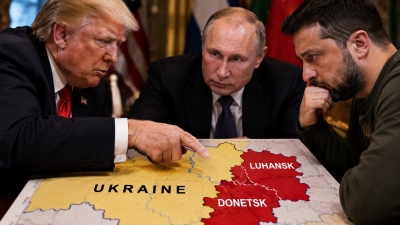
According to a report by The Economist, citing diplomatic sources, Washington is reviewing a scheme characterized by diplomats as a "cartographic ploy," as it envisions modifying the administrative borders of the Donetsk and Luhansk regions.
The objective of the proposal is to construct a framework wherein Moscow can assert full control over both regions without Kyiv being forced to surrender cities and territories that remain firmly under Ukrainian control.
This specific approach, if confirmed and pursued, would represent an effort to transcend territorial disputes through administrative boundary shifts rather than moving the actual operational line of control.
The "cartographic ploy" considered by Washington
The American initiative is reportedly grounded in the premise that redrawing administrative lines could grant Russia the political leeway to portray a negotiated settlement as the realization of its territorial war aims.
Presently, Moscow claims the entirety of the Donetsk and Luhansk oblasts, while Kyiv rejects ceding territories that remain under its sovereign control.
Under the proposed adjustment, Russia could claim to have secured full jurisdiction over both administrative entities as newly redefined.
Ukraine, for its part, would not be required to withdraw its armed forces from the remaining territory it controls.
However, such an arrangement would raise profound legal and geopolitical questions, since administrative border alterations do not automatically confer international recognition of sovereignty or a legitimate revision of state frontiers.
Furthermore, the formal mechanisms required to implement such a blueprint remain undefined, as does whether it would prove acceptable to the warring parties.
Trump rushes for a deal following midterm elections
According to sources cited by The Economist, Republican setbacks in the midterm elections for the US Congress have intensified the drive of Trump to accelerate negotiations regarding Ukraine.
Within this context, the US administration has reportedly tabled a series of proposals and prospective concessions to Moscow, designed to foster favorable conditions for a breakthrough.
These proposals include reintegrating Russia into European energy markets, notwithstanding the stated policy of the European Union to phase out Russian fossil fuel imports.
Concurrently, the package encompasses the administrative restructuring of the Donbass and the initiation of broader talks concerning the security architecture of Europe.
According to the report, US officials assert that these initiatives have secured backing from key European stakeholders and representatives within NATO.
However, the exact parameters of the proposals and the true extent of European consensus have not been officially disclosed.
Trump: Ukraine will have a "different shape" after the war
The public discourse surrounding potential territorial changes follows remarks made by Donald Trump during an interview on CBS program 60 Minutes.
The American president assessed that Ukraine will emerge with altered borders once hostilities conclude.
"I think that's what's going to happen. And when the war ends, Ukraine is going to be in a somewhat different shape," he stated.
Trump also asserted that the involved parties are very close to reaching an agreement, projecting himself as the decisive catalyst for halting the conflict.
His assertions reinforced calculations that the White House is actively exploring territorial accommodations as part of an overarching peace framework.
Kremlin: Ukraine is already a different country
Responding to the statements of the US president, Kremlin spokesman Dmitry Peskov argued on November 9 that geographical realities on the ground have already shifted irrevocably.
"As far as the shape of Ukraine is concerned, from a geographical point of view it is already a different country. The realities on the ground are obvious and hard to deny," he stated.
The intervention by Peskov reinforces the Russian doctrine that any peace settlement must reflect the prevailing territorial status quo.
Kyiv had issued no public response to the projections made by Trump, according to the report.
In contrast, French Foreign Minister Jean-Noël Barrot stated to Franceinfo that he remains committed to the current sovereignty of Ukraine, describing it as an independent state that has chosen to determine its own destiny and author its own history.
On the table: The return of Russia to European energy markets
One of the most consequential dimensions of the American proposals involves the potential reentry of Russia into European energy markets.
This option could function as an economic incentive for Moscow, given that Western sanctions and the drive to decouple from Russian hydrocarbons have severely curtailed traditional energy flows.
Nonetheless, executing such an arrangement would mandate consensus decisions by the European Union, as the United States cannot unilaterally dismantle European regulatory and sanctions regimes.
Consequently, any orchestrated return of Russia to continental energy grids could become a fresh theater of contention between Washington and European capitals.
New security architecture: Return to a Russia-NATO council framework
The dispatch in The Economist further discloses that Washington is contemplating a fundamental redesign of European security architecture in the post-war period.
According to its intelligence, the American side is evaluating a revamped model of the NATO-Russia Council, which could serve as the foundation for a reconstituted strategic dialogue and security mechanism across Europe.
Simultaneously, the United States is reportedly weighing bilateral security guarantees for Ukraine short of formal accession to the North Atlantic Alliance.
These guarantees could, according to US negotiators, mirror the provisions of Article 4 or Article 5 of the North Atlantic Treaty.
Article 4 mandates urgent consultations among allies when territorial integrity or security is threatened, while Article 5 enshrines collective defense in the event of an armed attack.
An arrangement containing equivalent commitments for Ukraine would not constitute formal NATO membership and would depend entirely on the explicit legal and military obligations assumed by guarantor powers.
The Economist: Unusual flexibility from Moscow
According to sources in the report, the Russian leadership has reportedly exhibited unusual tactical flexibility toward the new American proposals.
This posture pertains, among other elements, to the prospective cessation of hostilities along the current frontline.
However, Ukrainian interlocutors cited by The Economist remain deeply skeptical regarding the underlying intentions of Moscow.
By their assessment, Russia may exploit fresh diplomatic initiatives to prolong negotiations while sustaining offensive combat operations at least until the conclusion of its winter campaign.
Ukrainian negotiators are also reported to harbor severe doubts over whether Trump would honor future American security guarantees.
Despite these reservations, they have been directed to approach discussions with an open posture, primarily to avert fresh friction with the American administration.
The massive economic price of peace: An 800,000-strong standing army
Another major obstacle bedeviling negotiations centers on the astronomical financial cost of a post-war settlement.
According to The Economist, Kyiv demands vast economic and military commitments spanning at least a decade as a prerequisite for demobilization and accepting the reintegration of Russia into the Western economic sphere.
Ukrainian demands include guaranteed funding for war reparations, extensive support for veterans and their families, and the maintenance of fully combat-ready Armed Forces numbering no fewer than 800,000 active personnel.
The Ukrainian leadership views such long-term commitments as indispensable to guarantee the deterrence necessary to prevent a future Russian offensive.
Conversely, Washington reportedly assesses that the allies of Ukraine will be unable to shoulder such exorbitant long-term financial liabilities.
Under the US posture described in the report, Kyiv will need to rely on structured security guarantees rather than insisting on an open-ended, multi-year funding package.
Abu Dhabi: Potential localized truces in Kherson and Sumy
Despite acute divisions, sources cited by The Economist hold open the prospect that the two-day consultations in Abu Dhabi could produce localized breakthroughs.
Beyond prospective prisoner-of-war exchanges, negotiators are exploring localized truces across the Kherson and Sumy sectors.
These initiatives reportedly draw on the precedent of temporary local ceasefires brokered during humanitarian operations in Oleshky.
According to the report, corresponding understandings have already been facilitated with the assistance of the First Lady of the United States, Melania Trump, with Moscow signaling readiness to accommodate her efforts.
These disclosures do not, however, constitute confirmation of a comprehensive ceasefire or a definitive blueprint ending the conflict.
The real stake: Are borders shifting or the rules of European security?
The American initiative, as outlined by The Economist, seeks to merge three distinct axes of the Ukrainian crisis: territorial delineation, the economic normalization of Russia, and the codification of a revised security architecture across Europe.
The concept of redrawing the administrative demarcations of Donetsk and Luhansk could offer a linguistic compromise without necessarily resolving fundamental disputes over sovereignty and international border recognition.
At the same time, the potential revival of institutional dialogue between Russia and NATO, coupled with debates over restoring Moscow to European energy grids, indicates that ongoing talks could evolve far beyond a rudimentary ceasefire.
The defining question remains whether the Trump administration is laying the groundwork for a comprehensive reordering of European security, or if these proposals will collide with irreconcilable demands from Moscow and Kyiv, entrenching the diplomatic and military deadlock.
www.bankingnews.gr








Σχόλια αναγνωστών